Thought I would share some words that we received during training.
ATTITUDE by Charles Swindoll
"The longer I live, the more I realize the impact of attitude on life. Attitude, to me, is more important than facts. It is more important then the past, than education, than money, than circumstances, than failures, than successes, than what other people think or say or do. It is more important than appearance, giftedness or skill. It will make and break a company... a church... a home. The remarkable thing is we have a choice every day regarding the attitude we will embrace for that day. We cannot change our past... we cannot change the fact that people will act in a certain way. We cannot change the inevitable. The only thing we can do is play on the one string we have, and that is our attitude... I am convinced that life is 10 percent what happens to me and 90 percent how I react to it."
Saturday, May 10, 2008

Monday, April 21, 2008
Site Assignment Day
Friday was the long-awaited day for Tico 18. PCCR staff took us to a recreational facility for the day to relax after announcing our site assignments. After breakfast, we went to a room with a huge map of Costa Rica. Three PCTs volunteered to find out first, blindfolded. Think pin-the-tail-on-the donkey. Then, after brief descriptions of each site, we were called one by one to label our location on the map. From my interview, I was given little hints about where I would go but I really didn’t set myself up for any specific place. All I knew was that I wanted to work with youth and ecotourism. I had mentioned interest in immigration and indigenous issues but I didn't want to be too picky. I was sure that the staff would know best. So when I heard Luis mention the only indigenous site for the CED Program, I broke out a huge smile as he looked at me and said my name. I’ll be working in the “Dirty South” as some call it, a few hours from Panama and the Osa Peninsula. Next weekend, our counterparts will take us to our sites for the first time. From what I know, there are about 2500+ people in my community, who are mainly indigenous. It should take me four and a half hours to get to San Jose from my site. We were all given folders with detailed information about our communities and possible projects. Among the challenges I’m interested in addressing are problems with youth, improving business practices, English for tourism, and recollection of trash. Luckily, there are many organizations with which I can work, including a radio station and artisan groups. I’ll be living with a woman, her dog and cat, which is perfect. I’m so ready to go!
Wednesday, April 2, 2008
PCV Visits

This weekend, we all had a chance to meet and observe volunteers in various sites around the country. My group did so much, it felt like a week. The first community was my ideal site: semi-rural, pleasant and stable weather, beautiful views, and a laid-back atmosphere. Here, we met Emily who has been in her site for six months. After a game of soccer with local kids, Emily invited us to her home where her host mom showed us how to make empanadas de chiverre and cheese. During cafecito, Emily explained her projects and gave us some great ideas, such as organizing a community newsletter. After this, we went to the Feria Ambiental, where local artisans sold their work, among other venues and activities, including a bull ring attraction, in which people would ride and/or avoid getting attacked by angry bulls. Thankfully, no bulls are killed in the process. There was also outdoor karaoke and disco moviles, which was a fun way to spend the evening.
The next day, we went on a tour with the president of the community's Chamber of Tourism. In our tour, we visited a butterfly farm, a water-powered sugar cane mill, and hiked to see some springs, indigenous artifacts (known only to a few for protective reasons), and views of the valley. The sun was fierce, or as they say here, “Que luna!” After our tour, we walked to a nearby waterfall where we swam and ate our lunch. It was a long but worthwhile day. And my host family was great. I had two twin sisters who were always at my side, along with their cousins. Throughout my stay, the radio was always on a Catholic radio station. I heard a Christian reggaeton song for the first time, which was pretty amusing. During dinner, I would hear my host parents respond or sing to the radio programs. The girls also sang a really cute song thanking God for the food they were about to eat (with their dad’s request). Very different from my training host family.
For our next Volunteer visit, we drove to a small town similar to my training community. Instead of a main square, the town was long and centered on a main road. We met Rachel, who is leaving PC in six months. She invited us to a women’s group meeting, where we learned more about her efforts in the community. During this visit, our Program Director and PC Volunteer Coordinator interviewed each of us regarding our future site preferences. If possible, I would love to work with youth and indigenous peoples, with an emphasis in ecotourism and business education.
Behind my host family’s house is a waterfall and cabin, which my host dad built. On a break, I went with two other trainees to read there. My dream site definitely has a waterfall. All of us are anxious to know even just a clue about where they are planning to assign us. Two more weeks before we find out.
In the evening, I went with my host mother to a folkloric dance rehearsal for an upcoming presentation. I was excited to hear a song that my Spanish class had listened to one day: “Soy Tico”. The next day, Rachel invited us to her biweekly aerobics class. After a 45-minute walk uphill, we reached the salon comunal where five other ladies joined us. I would love to incorporate this activity in my future site. My arms are sore but no regrets.
In the afternoon, we had a tour of a local cheese finca. We divided into two teams for a series of fun activities to test our knowledge or to try something new. These included, identifying types of grass and supplemental diet for milking cows, extracting as much milk as possible from a cow, and making the best cheese. At the end of the day, we helped our tour guide plant some trees given to her by a government institution. Speaking of resources, I, among many, am truly impressed with the Instituto Nacional de Aprendizaje (INA). INA is an autonomous institution, created to prepare workers in a wide variety of areas, both independent workers and those needed by private companies. 1.5 percent of every worker’s salary is taken to fund INA, leaving it with a budget of approximately 40 million dollars. INA offers free courses and programs of study that include: agriculture, commerce & services, tourism, graphic industry, auto mechanics, metal mechanics, electric, fishing & sailing, textiles, food, technology of materials, and handicrafts processes. I hope I get a chance to work with INA while I’m here.
Monday, March 24, 2008
Overcoming my Fear of Cooking


I cooked my very first soup yesterday, and I am thrilled to say that it was a success (especially, with some jalapeño). It was a fish and root stew recipe I found online, a slight variation of the traditional olla de carne. My list of ingredients included tiquisque (which I needed to prepare for Spanish class), yucca, camote, carrot, potato, green plantain, onion, celery, garlic, cilantro, thyme, leek, chives, milk, butter, and fish. And I came out of this with only one cut on my finger. This may seem trivial but this really is an accomplishment for me. My parents would know. Anyway, we had a barbecue last night with a few other Volunteers. It was fun and the food was amazing. My host parents are really awesome and I'm really beginning to feel at home. I wasn't feeling too great last week but I thank God for listening to my prayers. Today, I went with the other Volunteers in my community to observe an English class in the local high school. We made observations, for future teaching reference. I also had the chance to interview some students about their educational and job opportunities, which were limited from their point of view. The best jobs require English and computer skills. In my community, the only jobs available are in construction and picking coffee. The other Volunteers and I have decided to ask youth that hang out by the park at night to be our focus group for our next non-formal education activity. If and when we get their consent and topic ideas, we'll plan a charla.
Saturday, March 22, 2008
Semana Santa

I'm stuck in an internet cafe waiting for the downpour to subside. Entering our third week of training, I'm anxious to know more about our assignments. We practiced our first non-formal education activity last week, and I'm beginning to realize how patient and well-prepared Volunteers need to be. Different learning styles, maintaining participant interest, preparation...there's lots of things to consider when facilitating or co-training people, let alone cultural norms and individual circumstances.
On Wednesday, my Spanish class and I went to the Feria del Agricultor in Desamparados, where we bought fruits and vegetables we've never heard of. Each of us chose one or two, which we have to prepare (depending on the fruit or vegetable) and bring to share in class on Monday. I chose tiquisque. It looks like yucca, which I love. But now I have to cook it. Not my forté. And online recipes are scarce. We'll see how that goes. Here's a list of other fruits and vegetables that made me wonder: jocote, mamón, anona, zapote, nances, pejibaye, tacaco, ñame, zapallo, vainica (This was my second selection but it turned out to be green beans...names!), camote, ayote, chayote, elote, ñampi. So yea, there's a lot.
My host mom did make me cas and carambola (star fruit) juices, which I tried for the first time. I highly recommend them. I also tried dulce de chiverre, which is traditionally made during Holy Week. I hear it takes hours of preparation.
Speaking of first', I went to see my first Motor Cross event last Saturday. My host parents want to see Monster Trucks soon, too. Good times.
Tuesday, March 11, 2008
First Impressions
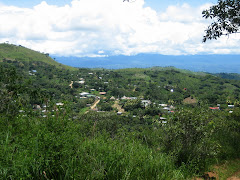
My training community is a small, peaceful town up in the mountains, near San Jose. With a population of approximately 7,000 people (it seems like less), a main road splits the town down the middle with houses and fincas stretching out on both sides. Most people work in San Jose, and many women stay at home to care for their children. Some of them have side businesses, as well.
My host family challenges most of what we were told to expect: machismo, strong religious values, and conservative thinking. Consequently, they stand out from the rest of the community. This is especially true for my host mom, who has always felt like she doesn’t belong. Light-skinned, blond-haired, with blue eyes, she looks different from most people here, including her immediate family. In school, girls would call her “gringa tonta” and reject her company. She would spend most of her time playing with boys and has always found it difficult to deal with other women. At home, my host mom’s parents discouraged her free spiritedness. Independent and nonconformist, she left for San Jose at an early age. Here she met another oveja negra, my host dad. Today, they live in union libre with their six-year-old son. (Despite the disapproval of the Catholic Church, more and more couples are opting to forgo marriage, probably given the high rate of divorces in the country.)
My host mom is not your typical ama de casa in Costa Rica. She does not spend most of her day cleaning the house or cooking. When her son is in school, she helps my host dad run his truck business. He restores used trucks, mostly parts from the U.S., and sells them in Costa Rica. When he’s working away from home, my host mom is in charge of the (male) employees. This makes some of them uncomfortable, she told me.
In our conversations, I’ve learned a great deal about Costa Rica that I probably wouldn’t have heard otherwise from other people in my community. According to my host parents, Costa Ricans are generally apathetic about politics and dislike confrontation. I’ve definitely been witness to the latter. In an essay assigned for Spanish class, “Costa Rica (Des)dibujada”, Jacqueline Murillo writes that free speech in Costa Rica is actually limited to inoffensive speech. She adds that people who insist on emphasizing real differences and recognizing problems are censured (8). My host mom confirmed that denial is part of the culture of avoiding conflict. And, as in my family’s case, it’s frowned upon to deviate from societal norms.
I was also surprised to learn about the gravity of internal issues facing Costa Rica. These include a high incidence of vehicle-related accidents, drug trafficking, and commercial child exploitation. My host mom is very critical about the country’s educational system, which has a high percentage of dropouts after grade school. Apparently, the high school curriculum is very boring and students prefer to find jobs and make money.
There is also a striking similarity between the U.S. and Costa Rica. Costa Rica has always welcomed waves of migrants seeking refuge or a new life, and it's now struggling with immigration issues, especially from Nicaragua. There are arguments however, that Nicaraguans take jobs that Ticos wouldn't (sound familiar?). There is also a growing population of Colombians who, thanks to the drug business, face some discrimination. Identity is also unclear given the country's "confluencia de culturas" (Murillo 1). High numbers of immigrants also put a strain on Costa Rica’s welfare system. In Costa Rica, healthcare is cheap and available to anyone. When my host mom got sick in Florida, they were shocked at the cost of treating her in a nearby hospital. “I could have flown to Costa Rica and back with that amount of money,” my host dad joked.
My host family challenges most of what we were told to expect: machismo, strong religious values, and conservative thinking. Consequently, they stand out from the rest of the community. This is especially true for my host mom, who has always felt like she doesn’t belong. Light-skinned, blond-haired, with blue eyes, she looks different from most people here, including her immediate family. In school, girls would call her “gringa tonta” and reject her company. She would spend most of her time playing with boys and has always found it difficult to deal with other women. At home, my host mom’s parents discouraged her free spiritedness. Independent and nonconformist, she left for San Jose at an early age. Here she met another oveja negra, my host dad. Today, they live in union libre with their six-year-old son. (Despite the disapproval of the Catholic Church, more and more couples are opting to forgo marriage, probably given the high rate of divorces in the country.)
My host mom is not your typical ama de casa in Costa Rica. She does not spend most of her day cleaning the house or cooking. When her son is in school, she helps my host dad run his truck business. He restores used trucks, mostly parts from the U.S., and sells them in Costa Rica. When he’s working away from home, my host mom is in charge of the (male) employees. This makes some of them uncomfortable, she told me.
In our conversations, I’ve learned a great deal about Costa Rica that I probably wouldn’t have heard otherwise from other people in my community. According to my host parents, Costa Ricans are generally apathetic about politics and dislike confrontation. I’ve definitely been witness to the latter. In an essay assigned for Spanish class, “Costa Rica (Des)dibujada”, Jacqueline Murillo writes that free speech in Costa Rica is actually limited to inoffensive speech. She adds that people who insist on emphasizing real differences and recognizing problems are censured (8). My host mom confirmed that denial is part of the culture of avoiding conflict. And, as in my family’s case, it’s frowned upon to deviate from societal norms.
I was also surprised to learn about the gravity of internal issues facing Costa Rica. These include a high incidence of vehicle-related accidents, drug trafficking, and commercial child exploitation. My host mom is very critical about the country’s educational system, which has a high percentage of dropouts after grade school. Apparently, the high school curriculum is very boring and students prefer to find jobs and make money.
There is also a striking similarity between the U.S. and Costa Rica. Costa Rica has always welcomed waves of migrants seeking refuge or a new life, and it's now struggling with immigration issues, especially from Nicaragua. There are arguments however, that Nicaraguans take jobs that Ticos wouldn't (sound familiar?). There is also a growing population of Colombians who, thanks to the drug business, face some discrimination. Identity is also unclear given the country's "confluencia de culturas" (Murillo 1). High numbers of immigrants also put a strain on Costa Rica’s welfare system. In Costa Rica, healthcare is cheap and available to anyone. When my host mom got sick in Florida, they were shocked at the cost of treating her in a nearby hospital. “I could have flown to Costa Rica and back with that amount of money,” my host dad joked.
Saturday, March 1, 2008
Training Begins
After a four day retreat, Tico 18, as we are called, will now move in with our host families for the next three months of training. It's been pretty overwhelming since we arrived but I am impressed with the quality of planning and organization demonstrated these past few days. Tico 18 is the largest group since Peace Corps arrived in Costa Rica 45 years ago. PC had graduated from Costa Rica in the mid-1990s but was asked to return with a new emphasis on micro-entreprise development. We are divided into three main projects: children, youth, and families; rural community development; and community economic development. Tomorrow, I will meet my new family: mom, dad, and son. I've never had a little brother so this should be fun.
Subscribe to:
Posts (Atom)