Monday, March 24, 2008

Overcoming my Fear of Cooking


I cooked my very first soup yesterday, and I am thrilled to say that it was a success (especially, with some jalapeño). It was a fish and root stew recipe I found online, a slight variation of the traditional olla de carne. My list of ingredients included tiquisque (which I needed to prepare for Spanish class), yucca, camote, carrot, potato, green plantain, onion, celery, garlic, cilantro, thyme, leek, chives, milk, butter, and fish. And I came out of this with only one cut on my finger. This may seem trivial but this really is an accomplishment for me. My parents would know. Anyway, we had a barbecue last night with a few other Volunteers. It was fun and the food was amazing. My host parents are really awesome and I'm really beginning to feel at home. I wasn't feeling too great last week but I thank God for listening to my prayers. Today, I went with the other Volunteers in my community to observe an English class in the local high school. We made observations, for future teaching reference. I also had the chance to interview some students about their educational and job opportunities, which were limited from their point of view. The best jobs require English and computer skills. In my community, the only jobs available are in construction and picking coffee. The other Volunteers and I have decided to ask youth that hang out by the park at night to be our focus group for our next non-formal education activity. If and when we get their consent and topic ideas, we'll plan a charla.

Saturday, March 22, 2008

Semana Santa


I'm stuck in an internet cafe waiting for the downpour to subside. Entering our third week of training, I'm anxious to know more about our assignments. We practiced our first non-formal education activity last week, and I'm beginning to realize how patient and well-prepared Volunteers need to be. Different learning styles, maintaining participant interest, preparation...there's lots of things to consider when facilitating or co-training people, let alone cultural norms and individual circumstances.

On Wednesday, my Spanish class and I went to the Feria del Agricultor in Desamparados, where we bought fruits and vegetables we've never heard of. Each of us chose one or two, which we have to prepare (depending on the fruit or vegetable) and bring to share in class on Monday. I chose tiquisque. It looks like yucca, which I love. But now I have to cook it. Not my forté. And online recipes are scarce. We'll see how that goes. Here's a list of other fruits and vegetables that made me wonder: jocote, mamón, anona, zapote, nances, pejibaye, tacaco, ñame, zapallo, vainica (This was my second selection but it turned out to be green beans...names!), camote, ayote, chayote, elote, ñampi. So yea, there's a lot.
My host mom did make me cas and carambola (star fruit) juices, which I tried for the first time. I highly recommend them. I also tried dulce de chiverre, which is traditionally made during Holy Week. I hear it takes hours of preparation.

Speaking of first', I went to see my first Motor Cross event last Saturday. My host parents want to see Monster Trucks soon, too. Good times.

Tuesday, March 11, 2008

First Impressions

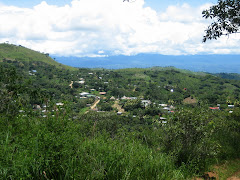
My training community is a small, peaceful town up in the mountains, near San Jose. With a population of approximately 7,000 people (it seems like less), a main road splits the town down the middle with houses and fincas stretching out on both sides. Most people work in San Jose, and many women stay at home to care for their children. Some of them have side businesses, as well.

My host family challenges most of what we were told to expect: machismo, strong religious values, and conservative thinking. Consequently, they stand out from the rest of the community. This is especially true for my host mom, who has always felt like she doesn’t belong. Light-skinned, blond-haired, with blue eyes, she looks different from most people here, including her immediate family. In school, girls would call her “gringa tonta” and reject her company. She would spend most of her time playing with boys and has always found it difficult to deal with other women. At home, my host mom’s parents discouraged her free spiritedness. Independent and nonconformist, she left for San Jose at an early age. Here she met another oveja negra, my host dad. Today, they live in union libre with their six-year-old son. (Despite the disapproval of the Catholic Church, more and more couples are opting to forgo marriage, probably given the high rate of divorces in the country.)

My host mom is not your typical ama de casa in Costa Rica. She does not spend most of her day cleaning the house or cooking. When her son is in school, she helps my host dad run his truck business. He restores used trucks, mostly parts from the U.S., and sells them in Costa Rica. When he’s working away from home, my host mom is in charge of the (male) employees. This makes some of them uncomfortable, she told me.

In our conversations, I’ve learned a great deal about Costa Rica that I probably wouldn’t have heard otherwise from other people in my community. According to my host parents, Costa Ricans are generally apathetic about politics and dislike confrontation. I’ve definitely been witness to the latter. In an essay assigned for Spanish class, “Costa Rica (Des)dibujada”, Jacqueline Murillo writes that free speech in Costa Rica is actually limited to inoffensive speech. She adds that people who insist on emphasizing real differences and recognizing problems are censured (8). My host mom confirmed that denial is part of the culture of avoiding conflict. And, as in my family’s case, it’s frowned upon to deviate from societal norms.

I was also surprised to learn about the gravity of internal issues facing Costa Rica. These include a high incidence of vehicle-related accidents, drug trafficking, and commercial child exploitation. My host mom is very critical about the country’s educational system, which has a high percentage of dropouts after grade school. Apparently, the high school curriculum is very boring and students prefer to find jobs and make money.

There is also a striking similarity between the U.S. and Costa Rica. Costa Rica has always welcomed waves of migrants seeking refuge or a new life, and it's now struggling with immigration issues, especially from Nicaragua. There are arguments however, that Nicaraguans take jobs that Ticos wouldn't (sound familiar?). There is also a growing population of Colombians who, thanks to the drug business, face some discrimination. Identity is also unclear given the country's "confluencia de culturas" (Murillo 1). High numbers of immigrants also put a strain on Costa Rica’s welfare system. In Costa Rica, healthcare is cheap and available to anyone. When my host mom got sick in Florida, they were shocked at the cost of treating her in a nearby hospital. “I could have flown to Costa Rica and back with that amount of money,” my host dad joked.

Saturday, March 1, 2008

Training Begins

After a four day retreat, Tico 18, as we are called, will now move in with our host families for the next three months of training. It's been pretty overwhelming since we arrived but I am impressed with the quality of planning and organization demonstrated these past few days. Tico 18 is the largest group since Peace Corps arrived in Costa Rica 45 years ago. PC had graduated from Costa Rica in the mid-1990s but was asked to return with a new emphasis on micro-entreprise development. We are divided into three main projects: children, youth, and families; rural community development; and community economic development. Tomorrow, I will meet my new family: mom, dad, and son. I've never had a little brother so this should be fun.