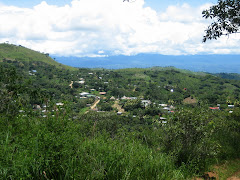
My training community is a small, peaceful town up in the mountains, near San Jose. With a population of approximately 7,000 people (it seems like less), a main road splits the town down the middle with houses and fincas stretching out on both sides. Most people work in San Jose, and many women stay at home to care for their children. Some of them have side businesses, as well.
My host family challenges most of what we were told to expect: machismo, strong religious values, and conservative thinking. Consequently, they stand out from the rest of the community. This is especially true for my host mom, who has always felt like she doesn’t belong. Light-skinned, blond-haired, with blue eyes, she looks different from most people here, including her immediate family. In school, girls would call her “gringa tonta” and reject her company. She would spend most of her time playing with boys and has always found it difficult to deal with other women. At home, my host mom’s parents discouraged her free spiritedness. Independent and nonconformist, she left for San Jose at an early age. Here she met another oveja negra, my host dad. Today, they live in union libre with their six-year-old son. (Despite the disapproval of the Catholic Church, more and more couples are opting to forgo marriage, probably given the high rate of divorces in the country.)
My host mom is not your typical ama de casa in Costa Rica. She does not spend most of her day cleaning the house or cooking. When her son is in school, she helps my host dad run his truck business. He restores used trucks, mostly parts from the U.S., and sells them in Costa Rica. When he’s working away from home, my host mom is in charge of the (male) employees. This makes some of them uncomfortable, she told me.
In our conversations, I’ve learned a great deal about Costa Rica that I probably wouldn’t have heard otherwise from other people in my community. According to my host parents, Costa Ricans are generally apathetic about politics and dislike confrontation. I’ve definitely been witness to the latter. In an essay assigned for Spanish class, “Costa Rica (Des)dibujada”, Jacqueline Murillo writes that free speech in Costa Rica is actually limited to inoffensive speech. She adds that people who insist on emphasizing real differences and recognizing problems are censured (8). My host mom confirmed that denial is part of the culture of avoiding conflict. And, as in my family’s case, it’s frowned upon to deviate from societal norms.
I was also surprised to learn about the gravity of internal issues facing Costa Rica. These include a high incidence of vehicle-related accidents, drug trafficking, and commercial child exploitation. My host mom is very critical about the country’s educational system, which has a high percentage of dropouts after grade school. Apparently, the high school curriculum is very boring and students prefer to find jobs and make money.
There is also a striking similarity between the U.S. and Costa Rica. Costa Rica has always welcomed waves of migrants seeking refuge or a new life, and it's now struggling with immigration issues, especially from Nicaragua. There are arguments however, that Nicaraguans take jobs that Ticos wouldn't (sound familiar?). There is also a growing population of Colombians who, thanks to the drug business, face some discrimination. Identity is also unclear given the country's "confluencia de culturas" (Murillo 1). High numbers of immigrants also put a strain on Costa Rica’s welfare system. In Costa Rica, healthcare is cheap and available to anyone. When my host mom got sick in Florida, they were shocked at the cost of treating her in a nearby hospital. “I could have flown to Costa Rica and back with that amount of money,” my host dad joked.
Tuesday, March 11, 2008

Saturday, March 1, 2008
Training Begins
After a four day retreat, Tico 18, as we are called, will now move in with our host families for the next three months of training. It's been pretty overwhelming since we arrived but I am impressed with the quality of planning and organization demonstrated these past few days. Tico 18 is the largest group since Peace Corps arrived in Costa Rica 45 years ago. PC had graduated from Costa Rica in the mid-1990s but was asked to return with a new emphasis on micro-entreprise development. We are divided into three main projects: children, youth, and families; rural community development; and community economic development. Tomorrow, I will meet my new family: mom, dad, and son. I've never had a little brother so this should be fun.
Monday, February 25, 2008
Day One
I arrived in D.C. this morning for Peace Corps orientation. There are about 50 Volunteers in my cohort, including two couples, and it's amazing how diverse our group is. From our introductions, I would have to say that at least half of the states are represented. Everyone seems great, and I can already sense the beginning of life-long friendships. As I learn more about the Peace Corps mission and experience, I feel much more confident about my decision. And I am especially happy to learn that we aim to become effective development facilitators, as opposed to outside "experts", via a participatory process. In this way, we are hoping to promote sustainability and empowerment.
I already feel like I am part of a family, and I can't wait to begin my service. It's been a long but worthwhile day.
I already feel like I am part of a family, and I can't wait to begin my service. It's been a long but worthwhile day.
Monday, February 18, 2008
Traveling
Traveling to me is like reading a widely recommended book that catches my interest. Whether it's the scenery or the culture, I have traveled to see and experience new things that have been recommended. And just like I rarely read a book more than once, I am always thinking about what novel place I will visit next. But now I will be returning to Costa Rica to work as a Peace Corps volunteer. I'll admit that I was a bit hesitant at first, and I was glad to read that the PC acknowledged my first reactions: Why there? Will people take me seriously when I tell them? I guess I had romanticized the idea of working in extremely harsh and isolated conditions, in a totally foreign culture. But as I read my welcome packet, I am considering the opportunities of returning to this beautiful country, knowing the language, and living in a community that is rarely seen by tourists, a role I played not too long ago.
Monday, November 26, 2007
3 days until the Constituent Assembly is finally ready to begin their work. Goodbye Congress! As for me, I have 2 weeks left. It'e been quite a busy month. For two weeks, NDI Ecuador organized strategic planning sessions with 9 major political parties and movements. Not one was the same and despite the four hours allotted, we extended into the night. It was great to see so much enthusiasm, or was it desperation? Acuerdo Pais has 80 assemblymen. Next comes PSP, with 16 seats, PRIAN 7, PSC 4, and you get the picture. It's been an interesting experience but I'm feeling restless. I think the Peace Corps is exactly what I need right now. Minus the time away from the people I love.
Sunday, October 28, 2007
Children on the streets
I am appalled at how many children there are living on the streets, begging for money with their toddler siblings, or selling cigarettes way past midnight. In the U.S., this would be an outrage. Of course, this is not to say that Ecuadorians do not care but there is a serious problem here. I think this is why I see myself working abroad. I'm looking into organizations that work with these kids, and I remember my research on MANTHOC, a child-worker's organization in Peru. Something has always told me that what I learned from them would influence my life. Here's an article about who they are and what they do:
http://www.shinealight.org/MANTHOC.html
My friend said that there's so much in this world to make you feel guilty. This is something I've struggled with but I think this is the battle I will choose.
http://www.shinealight.org/MANTHOC.html
My friend said that there's so much in this world to make you feel guilty. This is something I've struggled with but I think this is the battle I will choose.
Tuesday, October 23, 2007
All hope on Alianza Pais
Correa's movement Alianza Pais (AP) obtained more than 64% of seats in the Constituent Assembly, surpassing the minimum amount of votes needed to pass a resolution. Therefore, AP doesn't need to create alliances with minority representatives. The election results are a huge blow to traditional parties. But they indicate that Ecuadorians want change and they're placing their hope on a new movement, mainly on President Correa who talks about socialism of the 21st century. I've attended several forums regarding constitutional reform and feelings about the future are mixed. At NDI, we're working to help traditional parties who seek advise on internal reform by inviting international experts who can share their experiences. As for promoting democratic practices and institutions in and for the Constituent Assembly, we're hoping that AP will agree to work with us as we can offer comparative information on the theme of dissolving a national Congress and including public input for the new constitution.
Subscribe to:
Posts (Atom)